One Year Later: How Feldy Changed Me
- Published on
- Reading time
- 3 min
Introduction
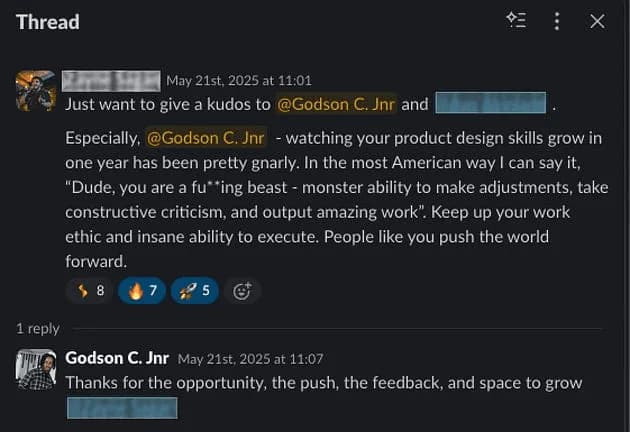
In 2024, I joined Aether through a referral from a good friend. At the time, she was the only designer on the team. That alone told me what kind of environment I was stepping into. I thought I was coming in to support. I didn’t realize I was stepping into a fast-moving product that would stretch how I think, design, and eventually lead.
The Reality of Startup Speed.
Startup speed sounds exciting until you’re inside it.
- A feature you designed on Monday could evolve by Thursday.
- A “quick fix” could lead to a complete redesign.
- A small improvement could turn into a full module (my favorite)
There were weeks I moved from refining onboarding experience to structuring pricing logic, then I was deep in automation flows. Some days looked like this:
- Morning: CRM pipeline rethink.
- Midday: AI agent setup flow debate.
- Evening: Slack thread about notification wording.
You learn to zoom in and zoom out fast. You stop thinking in single screens. You start thinking in systems. And you realize that speed forces clarity. If your thinking is messy, it shows immediately.
The Hard Parts
Not every week felt like progress.
Some weeks felt like survival. There were days I felt stretched thin, switching between problems and trying to understand the business impact behind every design decision no matter how small.
I learned that in startups, the word “simple” is usually a trap. “This should be simple.” That sentence alone means you’re about to discover:
- Five edge cases
- Three user types
- Two conflicting business goals
And somehow you still have to make it clean. One of the biggest lessons was understanding trade-offs. You rarely get enough time. There were times we shipped knowing it wasn’t perfect. Not broken! Sometimes you make small compromises to move fast. You tell yourself, “We’ll refine this later.”
That “later” becomes a list. And that list becomes design debt. I learned that speed has a cost. The real key is knowing which compromises are temporary and which ones quietly become permanent. That polite way of saying, “We’ll fix it in v2.”
What Actually Changed in Me
I stopped thinking like just a contributor. Less attached to my first idea. Less frustrated by iterations. The biggest change wasn’t in my skills. It was in how I think. I stopped designing screens. I started designing systems.
Closing Reflection
When I joined, I wanted to do good work. Now I want to build meaningful systems. When I joined, I wanted to ship features. Now I care about foundations. The work changed. The scope expanded. But the biggest shift happened internally. I became more intentional. And that’s the real win.
Technically, this reflection is late. It’s been over a year. I told myself I’d document the journey at the one-year mark. I got busy! Or lazy!! Or both!!! But maybe that delay says something too. When you’re building in real time, you rarely pause to measure how far you’ve come.